Showing posts with label news. Show all posts
Showing posts with label news. Show all posts
Monday, 1 May 2017


Thursday, 3 March 2016
Tuesday, 23 February 2016
Tuesday, 25 February 2014
Anti-gay law in Uganda
Uganda president set to sign anti-gay bill into law
- original article -
Ugandan President Yoweri Museveni will sign into law Monday a controversial bill that will see homosexuals jailed for life, despite international pressure, a government spokesman said.
"The president will sign the anti-homosexuality bill today," presidential spokesman Tamale Mirundi told AFP.
Museveni, a key African ally of the United States and the European Union, has already been under fire from key Western donors over alleged rampant corruption, and had been under pressure from diplomats and rights groups to block the legislation.
"The president cannot be pushed by the international lobby groups... he has made it clear whatever he does will be in the interests of Uganda and not foreign interests," Mirundi said.
"Uganda is a sovereign state and the decisions taken must be respected."
The lawmaker behind the bill, David Bahati, praised the decision to sign the bill.
"This is the moment the world has been waiting for," he told AFP.
Museveni, a devout evangelical Christian, earlier this month also signed into law anti-pornography and dress code legislation which outlaws "provocative" clothing, bans scantily-clad performers from Ugandan television and closely monitors what individuals watch on the Internet.
"We thank our President for taking such a bold move despite pressure from a section of foreign organisations," Bahati said.
"The law is for the good of Uganda, the current and the future generations."
Gay men and women in the country face frequent harassment and threats of violence, and rights activists have reported cases of lesbians being subjected to "corrective" rapes.
Tuesday, 1 October 2013
News: God "had a wife"
Finds in Israel add weight to theory God “had wife”
Female figurines and inscribed prayers to a "divine couple" found in temples in Israel suggest that the “one God” of the Bible may not have been entirely alone.

Female figurines and inscribed prayers to a "divine couple" found in temples in Israel suggest that the “one God” of the Bible may not have been entirely alone.
A recent excavation in Tel Motza, not far from Jerusalem, found what archaeologists believe to have been a ritual building - with clay figures of animals and men from the time of the First Temple, according to Israel's Haaretz news site.
The find suggests that Iron Age religion in the area around Jerusalem may not have been monotheistic just before the time the Hebrew Bible – the basis of the Old Testament - started to be written.
Now experts are increasingly suggesting that far from there being “one God”, there were many.
One expert, Professor Francesca Stavrakopoulou of the University of Exeter, says there is “increasing evidence” of Israelites worshipping several gods - including one who may have been seen as Yahweh’s “wife”.
Archaeologists Dr. Hamoudi Khalaily and Shua Kisilevitz, said, "The ritual building at Tel Motza is an unusual and striking find, in light of the fact that there are hardly any remains of ritual buildings of the period in Judaea at the time of the First Temple. Among other finds, the site has yielded pottery figurines of men, one of them bearded, whose significance is still unknown."
“The iconography points to a pantheon of deities, as some scholars believe, or to two main deities, something of a duality,” says archaeology writer Julia Fridman, writing in Israeli newspaper Haaretz.
“Interestingly, there are vastly more female figurines and representations found on shrines than there are male ones. The evidence points to the worship of at least two deities.”
Fridman points to discoveries in an 8th century tomb at the site of Khirbet el Qom, containing the names of YHWH - the God of the Bible - and a female figure, Ashera. Fridman says that the inscription appears to be a prayer, invoking both deities.
Another inscription, found at the site of Kuntillet Arjud, is dedicated to, ““YHWH and his ASHERA”. Such practices continued into the late Iron Age of the Land of Israel (10th–6th centuries BC), according to Fridman.
Professor Francesca Stavrakopoulou of the University of Exeter said, “There is increasing evidence that the ancient Israelites worshipped a number of gods alongside their ‘national’ patron deity, Yahweh. The goddess Asherah was among these deities.
“Not only is she mentioned in the Hebrew Bible (Old Testament), but inscriptions dating to the eighth and seventh centuries BCE attest to her worship alongside Yahweh in the kingdoms of Israel and Judah. Taken together, the biblical and archaeological evidence strongly suggests that Asherah was worshipped by some Israelites as the wife of Yahweh. They were likely a divine couple at the head of the local pantheon.”
Stavrakopoulou says that deities such as Asherah were “written out of history” as Yahweh became the “one God” of Jerusalem.
Theologians of the time were the scribes responsible for biblical texts - and Asherah’s appearances cast her as “foreign”, rather than as wife material.
“With the gradual emergence of monotheism in the sixth and fifth centuries BCE, a process in which Yahweh was increasingly prioritised over and above all other deities to the point at which the pantheon was ultimately rendered redundant, the goddess Asherah fell from favour among the leading theologians among Jerusalem’s elites,” Stavrakopoulou says.
“Many of these theologians were the scribes responsible for the production of biblical texts, and they sought to discredit and vilify the goddess of old by casting her as a deity ‘foreign’ and ‘abominable’ to traditional Yahweh-worship. As a result, she was falsely caricatured in the Bible either as a ‘Canaanite’ competitor to the Israelite god Yahweh (as in Torah and the Books of Kings), or as a lifeless wooden idol – an object to be destroyed by obedient to Yahweh’s demands that Israelites should worship him, and him alone (as in Deuteronomy).”
Other academics point to clay figurines of female forms as evidence that monotheism did not take hold instantly in the aera.
Erin Darby of the University of Tennessee-Knoxville says that female figurines were used widely - although perhaps not as a “religion” in the way we understand it today.
"The Judahite pillar figurines certainly tell us that many of the people who lived in Judah used small terracotta females in rituals that I strongly believe relate to protection and healing, most frequently taking place in homes and neighborhoods. This is especially true in Jerusalem,” Darby said in an interview with Haaretz.
The idea that Iron Age Israelites were strict “monotheists” is perhaps wrong, Darby suggests.
"I think you have tons of evidence to back this up, especially in Jerusalem and outlying areas like Motza. Not even the Bible claims that most ancient Judeans were strict monotheists," she said.
Thursday, 28 February 2013
"Gay Cure" Advert Banned
Christian group sues TfL after 'gay cure' advert banned from London buses
Mayor of London Boris Johnson, who is in charge of Transport for London (TfL), rejected the ad posters as "offensive to gays"
A Christian group has launched a High Court "battle for free speech" after its advert suggesting that gay people can be "cured" was banned from the sides of London buses.
The Mayor of London, who is in charge of Transport for London (TfL), rejected the ad posters as "offensive to gays".
Boris Johnson has also warned that displaying the ad could lead to a retaliation against the wider Christian community.
The rejected posters say: "Not Gay! Ex-Gay, Post-Gay and Proud. Get over it!"
They are in response to a poster campaign by gay rights group Stonewall, which plastered on the sides of the capital's red buses with the message: "Some people are gay. Get over it!"
The banned ad promotes the view of the Core Issues Trust that homosexuals can be "reoriented" through therapy and prayer.
Today Dr Mike Davidson, the head of the trust, asked Mrs Justice Lang to rule at London's High Court that the ban was unlawful and "a deep threat" to democratic freedoms.
Paul Diamond, appearing for Mr Davidson, told the judge: "We believe this is a very important free speech case on whether a totally temperate, restrained advertisement can be put on the sides of London buses."
Before the hearing started, Mr Davidson said: "I hope this hearing will give us the opportunity to put the case for securing some kind of future for people who want to move away from homosexuality and to be recognised as a valid group with needs to be protected and respected."
A TfL spokesman said: "The advertisement breached TfL's advertising policy as in our view it contained a publicly controversial message and was likely to cause widespread offence to members of the public."
Tuesday, 12 February 2013
Christian Sows Seeds and Reaps
Heavenly message in field took dedicated farmer twenty years to create
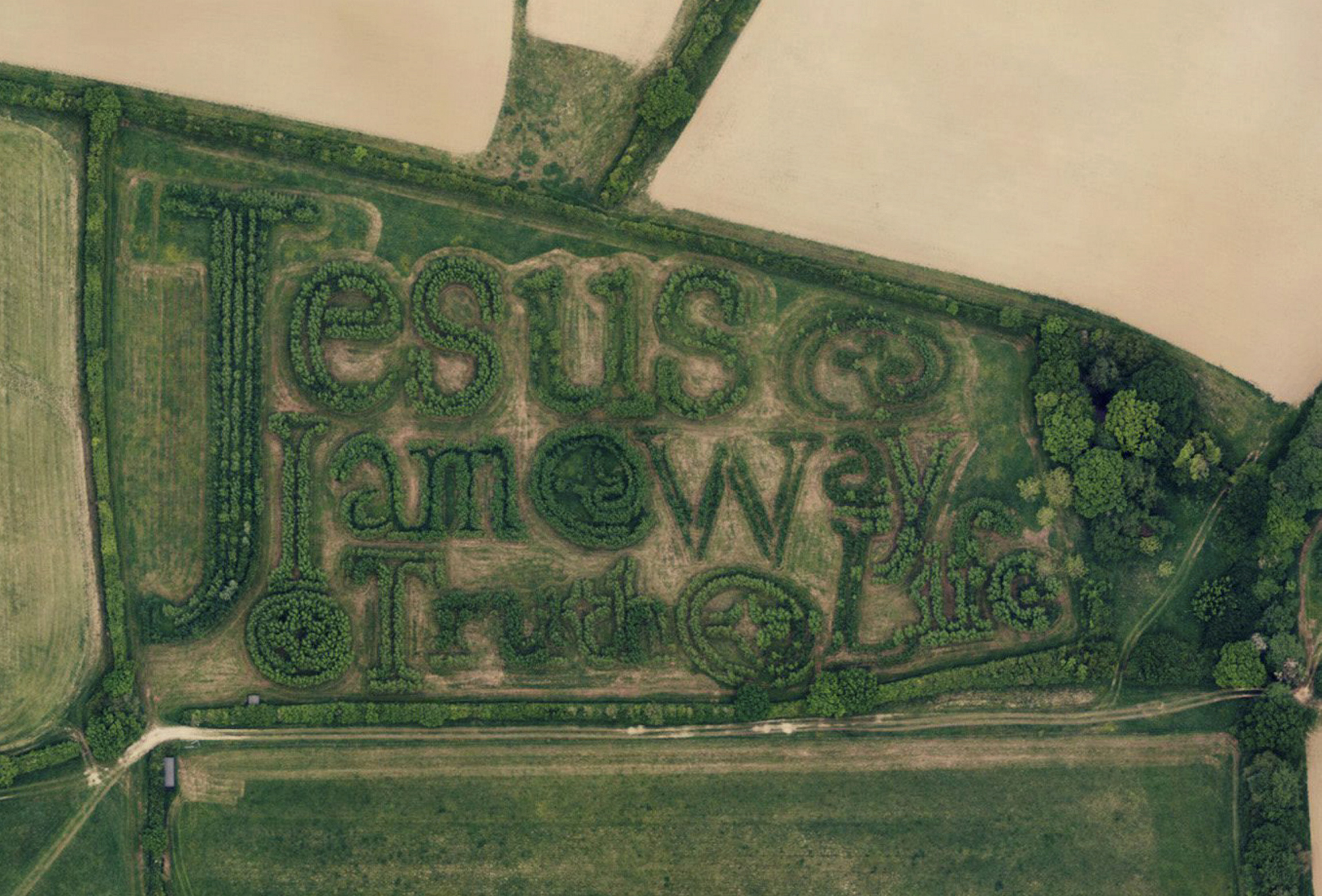
His first attempt in the 1990s was a disaster - a thorny mess of thistles
A farmer has reaped what he sowed after trees he planted 20 years ago finally revealed a message only those from above can read.
Peter Gunner, 62, planted dozens of willow trees two decades ago and has pruned them to spell out his favourite Bible passage, John 14:6: "Jesus said to him: 'I am the way, the truth, and life'."
But the message can only be seen from the air.
The committed Christian created his own Garden of Eden in his Sussex field so visitors wandering through the thick maze could experience his metaphor for life.
He said: "You walk around in it but you don't really know what your life is going to look like from above."
The creation at his home Burchetts Farm is the second time he has attempted the ambitious project.
His first attempt in the 1990s was a disaster. Instead of forming in a pretty pattern of words he ended up with a thorny mess of thistles which mean he had to start all over again.
For his second attempt the religious farmer mapped the words on a computer before getting to work on the field armed with a tape measure and string.
Despite years of pruning Mr Gunner only saw his labor of love for the first time recently, when a police officer neighbour gave him an aerial picture taken for a helicopter.
Unfortunately, the aerial images highlighted slight mistakes in his creation - the top of the J is slightly wonky and the 'a' in 'am' is askew - but he hopes to fix them one day.
Friday, 1 February 2013
Transitional Fossil Found
Scientists identify crocodile ancestor among fossils discovered a century ago
Tyrannoneustes lythrodectikos, whose remains lay unidentified in a museum, was a super-predator with dolphin-like features.
A creature resembling a hybrid dolphin and crocodile has been identified by scientists examining fossil remains discovered more than a century ago.
The new species, named Tyrannoneustes lythrodectikos, was a marine "super-predator" that lived 163m years ago. It belonged to a group of ancient crocodiles with dolphin-like features.
An amateur fossil hunter found the reptile's partial skeleton in a clay pit near Peterborough in the early 1900s. Experts have only now been able to confirm the identity of the remains, housed at the Hunterian Museum at the University of Glasgow.
The animal had pointed, serrated teeth and a large gaping jaw suited to feeding on large-bodied prey. It represents a transitional form between marine crocodiles that fed on small prey and their supersized relatives.
Dr Mark Young, from the University of Edinburgh, said: "It is satisfying to be able to classify a specimen that has been unexamined for more than 100 years, and doubly so to find that this discovery improves our understanding of the evolution of marine reptiles."
Dr Neil Clark, palaeontology curator at the Hunterian, said: "Little research has been done on this specimen since it was first listed in 1919. It is comforting to know that new species can still be found in museums as new research is carried out on old collections.
"It is not just the new species that are important, but an increase in our understanding of how life evolved and the variety of life forms that existed 163m years ago in the warm Jurassic seas around what is now Britain."
The research appears in the Journal of Systematic Palaeontology.
The new species, named Tyrannoneustes lythrodectikos, was a marine "super-predator" that lived 163m years ago. It belonged to a group of ancient crocodiles with dolphin-like features.
An amateur fossil hunter found the reptile's partial skeleton in a clay pit near Peterborough in the early 1900s. Experts have only now been able to confirm the identity of the remains, housed at the Hunterian Museum at the University of Glasgow.
The animal had pointed, serrated teeth and a large gaping jaw suited to feeding on large-bodied prey. It represents a transitional form between marine crocodiles that fed on small prey and their supersized relatives.
Dr Mark Young, from the University of Edinburgh, said: "It is satisfying to be able to classify a specimen that has been unexamined for more than 100 years, and doubly so to find that this discovery improves our understanding of the evolution of marine reptiles."
Dr Neil Clark, palaeontology curator at the Hunterian, said: "Little research has been done on this specimen since it was first listed in 1919. It is comforting to know that new species can still be found in museums as new research is carried out on old collections.
"It is not just the new species that are important, but an increase in our understanding of how life evolved and the variety of life forms that existed 163m years ago in the warm Jurassic seas around what is now Britain."
The research appears in the Journal of Systematic Palaeontology.
Thursday, 31 January 2013
UK Mps to vote on Gay Marriage
Gay marriage: MPs set to vote on proposals for the first time
MPs are set to get their first chance to vote on plans to allow same-sex marriages in England and Wales.
The bill will allow same-sex marriage and let religious organisations which want to, to offer them, the culture department says.
The plans have divided the Conservative Party - its MPs will get a free vote.
Labour and the Lib Dems back the proposals to legalise same-sex marriage, but Labour said the exemption for the established Church was "disappointing".
The Church of England and Roman Catholics, among other denominations, have voiced opposition to the plans and are expected to oppose the bill, even with its caveats.
But some religious groups, including Quakers, Unitarians and Liberal Judaism, are in favour.
Culture Secretary Maria Miller told the Commons in December that no religious organisation "will ever be forced to conduct marriages for same-sex couples".
She said the legislation - which will published on Friday ahead of the bill's second reading - would include a "quadruple lock" to protect religious freedom.
Faith schools
The bill is set to specifically exclude the Church of England and Church in Wales to avoid a clash between Canon Law - which defines marriage as that between a man and a woman - and UK civil law.
But a spokesman for the Department for Culture, Media and Sport said that if the Church of England did want to opt-in to offering same-sex marriages it could, saying a process for doing so was to be set out in the bill.
A public consultation on plans for same-sex marriage received 228,000 submissions.
In its response to the consultation the government says it has no plans to change the definition of adultery or non-consummation of a marriage - which means neither could be cited as grounds for divorce in a same-sex marriage, unless the adultery was with someone of the opposite sex.
They also dismiss the fear that the terms "husband" and "wife" could be removed as a result of same sex marriages.
They also say that teachers "particularly in faith schools will be able to continue to describe their belief that marriage is between a man and woman whilst acknowledging and acting within the new legislative position which enables same sex-couples to get married".
The Scottish Government has published proposed legislation of its own to introduce gay marriage.
Under the plans, religious and faith groups would need to "opt in" to perform same-sex marriages.
Wednesday, 30 January 2013
Muslim patrols... in London
'Muslim patrol' investigation leads to double arrest
Homophobic attack filmed and uploaded to YouTube among a series of incidents by east London vigilante groupTwo men have been arrested after a series of incidents in London saw members of the public harassed by self-styled vigilantes who posted footage of their activities online. One included a clip showing a man being subjected to homophobic abuse.
The incidents are believed to be linked to a group claiming to be behind "Muslim patrols" of Whitechapel. In the latest video in which a group of men described themselves as "vigilantes implementing Islam upon your own necks", a man is followed and told: "Get out of here you fag … Don't stay around here any more."
His pursuers tell him that he is "walking through a Muslim area dressed like a fag".
The East London Mosque has condemned the actions. It said in a statement last week that individuals claiming to be 'Muslim patrols' have been harassing members of the public on the streets of east London late at night, including outside the mosque after it has closed, and that it had contacted the police to alert them to the presence of the individuals and video.
"These actions are utterly unacceptable and clearly designed to stoke tensions and sow discord," it said.
"We wholly condemn them. The East London Mosque is committed to building co-operation and harmony between all communities in this borough. The actions of this tiny minority have no place in our faith nor on our streets.
The gay rights group, Stonewall, said: "This incident is yet another reminder of the homophobic abuse that gay people face all too often. We urge victims of all homophobic crimes and incidents to report them to the police and for the police to take action to protect gay people from these disturbing crimes."
The Metropolitan Police said that two men were arrested in connection with a series of incidents that took place over the course of 12-13 January in east London. Videos of the incidents were later uploaded onto YouTube.
A 22-year-old man was arrested in Acton on Sunday while a 19-year-old man voluntarily attended an east London police station on Monday.
A Met spokesperson said: "The pair were arrested on suspicion of GBH and Public Order offences and have been bailed to return to an east London police station on a dates in February and March pending further enquiries.
"The Metropolitan Police Service takes these incidents very seriously and is pursuing various lines of enquiry with a view to identifying and prosecuting the individuals concerned.
The incidents are believed to be linked to a group claiming to be behind "Muslim patrols" of Whitechapel. In the latest video in which a group of men described themselves as "vigilantes implementing Islam upon your own necks", a man is followed and told: "Get out of here you fag … Don't stay around here any more."
His pursuers tell him that he is "walking through a Muslim area dressed like a fag".
The East London Mosque has condemned the actions. It said in a statement last week that individuals claiming to be 'Muslim patrols' have been harassing members of the public on the streets of east London late at night, including outside the mosque after it has closed, and that it had contacted the police to alert them to the presence of the individuals and video.
"These actions are utterly unacceptable and clearly designed to stoke tensions and sow discord," it said.
"We wholly condemn them. The East London Mosque is committed to building co-operation and harmony between all communities in this borough. The actions of this tiny minority have no place in our faith nor on our streets.
The gay rights group, Stonewall, said: "This incident is yet another reminder of the homophobic abuse that gay people face all too often. We urge victims of all homophobic crimes and incidents to report them to the police and for the police to take action to protect gay people from these disturbing crimes."
The Metropolitan Police said that two men were arrested in connection with a series of incidents that took place over the course of 12-13 January in east London. Videos of the incidents were later uploaded onto YouTube.
A 22-year-old man was arrested in Acton on Sunday while a 19-year-old man voluntarily attended an east London police station on Monday.
A Met spokesperson said: "The pair were arrested on suspicion of GBH and Public Order offences and have been bailed to return to an east London police station on a dates in February and March pending further enquiries.
"The Metropolitan Police Service takes these incidents very seriously and is pursuing various lines of enquiry with a view to identifying and prosecuting the individuals concerned.
Tuesday, 29 January 2013
Mars May Have Had Life
Mars: 'Strongest evidence' planet may have supported life, scientists say
Minerals found underground on Mars are the "strongest evidence yet" that the planet may have supported life, according to new research.
They used data from the US space agency (Nasa) and European Space Agency (Esa).
Nature Geoscience has published the research.
The team said the research backed up the existing theory that Mars could have supported life due to micro-organisms hidden beneath the surface.
They said that when meteorites strike the surface of Mars, they act as natural probes, bringing up rocks from far below.
The McLaughlin Crater is described as one such area of interest in the study.
Dr Joseph Michalski, lead author and planetary geologist at the Natural History Museum, said: "We don't know how life on Earth formed but it is conceivable that it originated underground, protected from harsh surface conditions that existed on early Earth.
"However, the early geological record of Earth is poorly preserved so we may never know what processes led to life's origin and early evolution.
"Whether the Martian geologic record contains life or not, analysis of these types of rocks would certainly teach us a tremendous amount about early chemical processes in the solar system.
"In this paper, we present a strong case for exploring the subsurface, as well as the surface.
"But I don't personally think we should try to drill into the subsurface to look for ancient life. Instead, we can study rocks that are naturally brought to the surface by meteor impact and search in deep basins where fluids have come to the surface."
'Be clever'
Co-author Prof John Parnell, geochemist at the University of Aberdeen, added: "This research has demonstrated how studies of Earth and Mars depend on each other.
"It is what we have observed of microbes living below the continents and oceans of Earth. They allow us to speculate on habitats for past life on Mars, which in turn show us how life on the early Earth could have survived.
"We know from Earth's history that planets face traumatic conditions such as meteorite bombardment and ice ages, when the survival of life may depend on being well-below ground.
"So it makes sense to search for evidence of life from that subsurface environment, in the geological records of both Earth and Mars.
"But it's one thing to do that on Earth - we need to be clever in finding a way to do it on Mars."
Saturday, 26 January 2013
Beheadings in Nigeria
Nigerian militants suspected of Maiduguri beheadings
original articleSuspected militant Islamists have beheaded five people in Nigeria's north-eastern city of Maiduguri, a resident has told the BBC.
However, the military told the BBC only three people had been killed.
At least 23 others have been killed in separate attacks in the north this week blamed on militants wanting to impose Islamic law on Nigeria.
The insurgency was launched by Boko Haram in Maiduguri in 2009, but a second militant group, Ansaru, emerged last year.
Last month, suspected militants slit the throats of at least 15 Christians near Maiduguri.
In the latest attack, the assailants first beheaded a father and son at their home, before beheading two other men at their residence and a fifth person at another house in Maiduguri, said a resident, who spoke to the BBC Hausa service on condition of anonymity.
It is unclear who carried out the attacks or what their motives were, but there are strong suspicions that Boko Haram was involved, the resident said.
Hunters killed
A Maiduguri-based journalist confirmed the resident's account to the BBC.
But army spokesman Lt-Col Sagir Musa said suspected gunmen killed three people during the attack.
The joint task force - made up of soldiers and policemen - rushed to the scene when it was alerted, he said.
"It cordoned off the area, arrested three suspects and recovered one assault rifle with ten rounds of ammunition," Lt-Col Musa said.
"Two gunmen lost their lives and a soldier was wounded during an exchange of fire."
On Monday, gunmen apparently targeted hunters selling bush meat in Damboa in north-east Nigeria, killing 18 people, witnesses said.
Another five people died on Tuesday when a group of men playing draughts was attacked in Kano.
No group has said it is responsible for the attacks.
Strict Muslims believe it is forbidden to eat animals such as monkeys or to play games that could influence people to take up gambling.
These attacks followed an attempt on the life of the second most important Muslim leader in Nigeria, the Emir of Kano, whose convoy came under fire on Sunday. He survived but several of his guards were killed.
Boko Haram has been blamed for the deaths of some 1,400 people in central and northern Nigeria since 2010.
Last year alone, the group was linked to more than 600 deaths.
Ansaru announced its existence last June.
In December, it said it had kidnapped French national Francis Colump in the northern Katsina state.
Friday, 25 January 2013
Vicars on the Catwalk
Churchgoers flock to catwalk show for VICARS
original article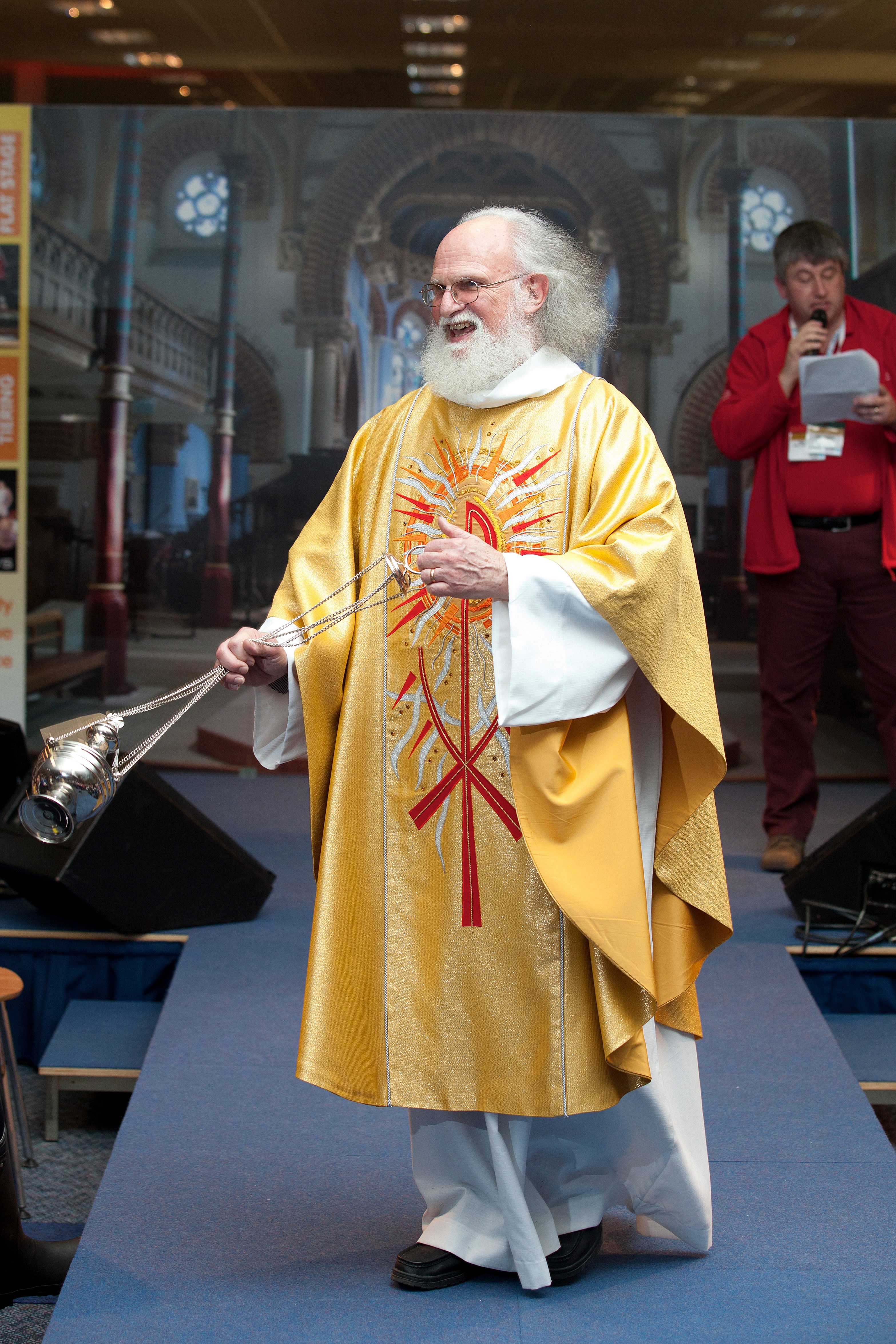
The Clergy Catwalk in Bristol showcased every item needed by the clergy, from candles and clerical shirts to collars and archbishops' robes.
Strutting their stuff on the clergy catwalk, churchgoers check out the latest in ecclesiastical wear during a fashion show for vicars.
Five members of the clergy showed off the new, cutting edge brightly-coloured robes at an event designed to shake off the 'dusty' image of the church.
The Clergy Catwalk in Bristol showcased every item needed by the clergy, from candles and clerical shirts to collars and archbishops' robes.
Blinged up crucifix and cross necklaces were also on show, along with a capsule collection of "leisure pieces" for the busy vicar.
Five members of the clergy showed off the new, cutting edge brightly-coloured robes at an event designed to shake off the 'dusty' image of the church.
The Clergy Catwalk in Bristol showcased every item needed by the clergy, from candles and clerical shirts to collars and archbishops' robes.
Blinged up crucifix and cross necklaces were also on show, along with a capsule collection of "leisure pieces" for the busy vicar.
The high fashion event saw hundreds of churchgoers jostle for a place on the show's front row as the group revealed cutting edge frocks in bright colours.
Steve Goddard, from the CRE, said the fashions - ranging from just £30 to more than £1,000 - were of great interest to those attending the exhibition.
He said: "The gear being modelled is by designers who specialise in clerical wear. Their companies are devoted to it.
"They design everything needed by members of the clergy, from clerical shirts and collars to archbishop's robes.
"We have ranges from two clothing designers, a t-shirt maker, and jewellery because of the current issue of wearing religious items as jewellery.
"The items range from robes to leisure pieces to wear around the parish when you might want to look more discreet, such as blouses for ladies and shirts for men."
The CRE was attended by 2,000 members of the clergy, who crowded round the catwalk at 11.30am for the 30 minute show.
A total of 20 items were modelled, with designs from respected Hayes and Finch and Juliet Hemingray - who created robes for former Archbishop of Canterbury George Carey's enthronement - on show.
Beth Allison, minister-in-training at Market Bosworth Free Church in Leics was the first to take to the catwalk, wearing a Lord's Prayer bead necklace by Silverfish Jewellery.
She was followed by retired United Reform Reverend Tom MacMeekin wearing a Juliet Hemingray "bling" chasuble.
Steve added: "This show-stopper has arm sections filled with vertical stripes of appliqued fabrics in gold and white, with a central panel a blend of brocade and metallic silks.
"It also features Swarovski crystals. Tom has always believed that ministers should wear bright colours instead of black, like a lot of members of clergy."
Steve Goddard, from the CRE, said the fashions - ranging from just £30 to more than £1,000 - were of great interest to those attending the exhibition.
He said: "The gear being modelled is by designers who specialise in clerical wear. Their companies are devoted to it.
"They design everything needed by members of the clergy, from clerical shirts and collars to archbishop's robes.
"We have ranges from two clothing designers, a t-shirt maker, and jewellery because of the current issue of wearing religious items as jewellery.
"The items range from robes to leisure pieces to wear around the parish when you might want to look more discreet, such as blouses for ladies and shirts for men."
The CRE was attended by 2,000 members of the clergy, who crowded round the catwalk at 11.30am for the 30 minute show.
A total of 20 items were modelled, with designs from respected Hayes and Finch and Juliet Hemingray - who created robes for former Archbishop of Canterbury George Carey's enthronement - on show.
Beth Allison, minister-in-training at Market Bosworth Free Church in Leics was the first to take to the catwalk, wearing a Lord's Prayer bead necklace by Silverfish Jewellery.
She was followed by retired United Reform Reverend Tom MacMeekin wearing a Juliet Hemingray "bling" chasuble.
Steve added: "This show-stopper has arm sections filled with vertical stripes of appliqued fabrics in gold and white, with a central panel a blend of brocade and metallic silks.
"It also features Swarovski crystals. Tom has always believed that ministers should wear bright colours instead of black, like a lot of members of clergy."
Thursday, 24 January 2013
Murderer 'Forgiven by God'
Barry Reeve murder trial: Accused 'forgiven by God'
original articleA woman accused of murdering a 67-year-old man has told a court she was not responsible for his death and said: "I've been forgiven by God."
She and Kelly Barnes, 32, formerly of Bixley Close, Norwich, are accused of the torture and murder of retired bus conductor Barry Reeve.
Both women, who are civil partners, deny the charge.
Earlier, Kelly Barnes told the court they had visited Mr Reeve's bungalow in Corton Road, Norwich, on 9 February last year but claimed she did not witness an attack.
She then said her partner told her while they were both being held at Peterborough prison that she had killed Mr Reeve.
'The gospel truth'
Jodie Barnes, who asked to be called by her maiden name of Ramsbottom, denied making the confession.
"I prayed about this, it's the gospel truth that I have not said anything to Kelly about any incident," she said.
"I know I've been forgiven by God. I get visions from him all the time."
Jodie Barnes told the court the couple had spent up to £400 a week on heroin and crack cocaine and said that on the day of the killing they had no money.
The drug addicts visited Mr Reeve who had previously lent them money.
Her sexual services were offered to Mr Reeve by Kelly Barnes but he said he wanted Kelly instead, the jury heard.
She said there was a "ruck" and added: "Kelly freaked out, she did it, she did it. I was getting flashbacks about it in prison."
Still alive
Jodie Barnes admitted taking Mr Reeve's wallet as he lay injured, but denied returning to the bungalow later that night to empty the freezer.
She told the court Kelly Barnes had returned but she stayed at home "reading my Bible all night".
Prosecutor Karim Khalil QC has told the court the pair tortured Mr Reeve in an attempt to force him to disclose his bank account personal identification number.
He said that after the killing they made several attempts to withdraw money from a cash machine using his debit card, then took a taxi back to his home to steal valuables.
Pathologist Nat Cary said that he believed Mr Reeve had lived for at least 24 hours after the attack - meaning he was still alive when they returned.
Mr Reeve's body was found in his blood-spattered home two weeks later when his daughter called to visit.
The case continues.
Thursday, 17 January 2013
Text books have Anatomy 'wrong' in early animals
Tetrapod anatomy: Backbone back-to-front in early animals
original articleTextbooks might have to be re-written when it comes to some of the earliest creatures, a study suggests.
The findings, published in the journal Nature, may even change our thinking on how the spine evolved.
The scientists looked at a group of animals called the tetrapods, examining three creatures called Ichthyostega, Acanthostega and Pederpes.
These primitive four-legged animals are of great interest to palaeontologists: they were the first creatures to haul themselves out of the oceans, paving the way for all future vertebrate life on land.
Studying how these animals are put together is key to understanding how they made this transition.
The researchers from the University of Cambridge and the Royal Veterinary College (RVC) used the European Synchrotron Radiation Facility (ESRF) to bombard the 360-million-year old fossils with high energy X-rays.
This enabled them to create detailed computer reconstructions of the prehistoric animals.
RVC's Prof John Hutchinson said: "Their vertebrae are actually structurally completely different from what everyone for the last 150 or so years has pictured. The textbook examples turn out to be wrong."
The scientists found that parts of the spine thought to face the front of the animal, in fact faced the back - and vice versa.
They also discovered the earliest known evidence of a breastbone in Ichthyostega.
Prof Hutchinson said the findings provided more clues about how the early animals physically moved out of the water and on to land.
An earlier paper by the same team suggested that the tetrapods dragged themselves out of the sea, using their front legs to haul the rest of their body along the ground. The new anatomical findings backed this up, Prof Hutchinson said.
The study also shed more light on how the modern backbone evolved.
He explained: "All of that anatomy [from these early land animals ] was handed down to later animals.
"It influenced the future evolution of the spine in everything on land. It tells us about our own development and why our own backbones developed they way they did."
Wednesday, 16 January 2013
French Protest Against Same-Sex Marriage
Protesters rally against same-sex marriage in France
original articleThey converged near the Eiffel Tower, chanting and waving flags, posters and balloons.
"I do not personally agree with gay marriage as I am a Christian and believe what the Bible says about marriage being between one woman and one man for a life time," said CNN iReporter Oluwasegun Olowu-Davies, who shot video of the march with his phone.
"If your lifestyle doesn't allow you to conceive, there is a reason," he said.
Extending the right to marry and adopt to same-sex couples was one of President Francois Hollande's electoral pledges in campaigning last year.
After his win, the Cabinet approved a draft bill that is expected to go before the National Assembly and Senate soon. It is likely to be voted on in February or March. If passed, it would mark the biggest step forward for French gay rights advocates in more than a decade.
The plan faces stiff opposition from the Roman Catholic Church and social conservatives.
Cardinal Andre Vingt-Trois, the archbishop of Paris, voiced his opposition at a meeting of French bishops in Lourdes last year.
Opening up marriage to same-sex couples "would be a transformation of marriage that would affect everyone," he said.
At the same time, failing to recognize gender difference within marriage and the family would be a "deceit" that would rock the foundations of society and lead to discrimination between children, he said.
Other religious groups in France, including Muslims, Jews and Buddhists, have also expressed their concern over the draft bill, and more than 100 lawmakers are against the legislation, according to CNN affiliate BFMTV.
Hundreds of mayors around the country have also voiced their opposition, which has won wide backing from gay rights advocates.
The French gay, lesbian and transgender rights group Inter-LGBT said the law, if passed, "would be a major advance for our country in terms of equality of rights."
Lawmakers have a "unique opportunity" to put an end to outdated discrimination, the group said in a statement. "The law must allow all couples to unite themselves as they wish and must protect all families, without discrimination on the grounds of sexual orientation or gender identity," it said.
A law legalizing civil unions was introduced in 1999 in France under a previous Socialist government.
Known in France as the PACS (pacte civil de solidarite), the civil union agreement can be entered into by gay or straight couples and confers many but not all of the rights of marriage.
Tuesday, 15 January 2013
Science tests wrinkled fingers
Science puts wrinkled fingers to the test
original article
Science may be getting closer to explaining those prune-like fingers and toes we all get when we sit in a hot bath too long.
They suggest our ancestors may have evolved the creases as they moved and foraged for food in wet conditions.
Their experiments are reported in the Royal Society journal Biology Letters.
These involved asking volunteers to pick up marbles immersed in a bucket of water with one hand and then passing them through a small slot to be deposited by the other hand in a second container.
Volunteers with wrinkled fingers routinely completed the task faster than their smooth-skinned counterparts.
The team found there was no advantage from ridged fingers when moving dry objects. This suggests that the wrinkles serve the specific function of improving our grip on objects under water or when dealing with wet surfaces in general.
For a long time, it was assumed that the wrinkles were simply the result of the skin swelling in water, but recent investigations have actually shown the furrows to be caused by the blood vessels constricting in reaction to the water, which in turn is a response controlled by the body's sympathetic nervous system.
That an active system of regulation is at work led scientists into thinking there must be some deeper evolutionary justification for the ridges.
"If wrinkled fingers were just the result of the skin swelling as it took up water, it could still have a function but it wouldn't need to," said Dr Tom Smulders, from Newcastle's Centre for Behaviour and Evolution.
"Whereas, if the nervous system is actively controlling this behaviour under some circumstances and not others, it seems less of a leap to assume there must be a function for it, and that evolution has selected it. And evolution wouldn't have selected it unless it conferred some sort of advantage," he told BBC News.
US-based researchers were the first to propose that the wrinkles might act like the tread on tyres, and even demonstrated how the patterns in the skin resembled those of run-off channels seen on the sides of hills.
Wet trees
What the Newcastle team has now done is confirm that prune-like fingers are indeed better at gripping wet objects.
"We have tested the first prediction of the hypothesis - that handling should be improved," Dr Smulders said.
"What we haven't done yet is show why - to see if the wrinkles remove the water, or whether it's some other feature of those wrinkles such as a change in their stickiness or plasticity, or something else. The next thing will be to measure precisely what's happening at that interface between the objects and the fingers."
Our ancestors might not have played with wet marbles, but having better gripping fingers and feet would certainly have been advantageous as they clambered about and foraged for food along lake-shores and by rivers.
It would be interesting to see, observed Dr Smulders, just how many other animals displayed this trait - in particular, in primates.
"If it's in many, many primates then my guess is that the original function might have been locomotion through wet vegetation or wet trees. Whereas, if it's just in humans that we see this then we might consider something much more specific, such as foraging in and along rivers and the like."
Monday, 14 January 2013
Haul of comets around other stars
'Exocomet' numbers nearly tripled in new study
original article
A new haul of comets around distant stars has been unveiled, more than doubling the number we know of.
At the 221st American Astronomical Society meeting in the US, astronomer Barry Welsh gave details of seven more.
Proving that comets are common in the Universe has implications for their role in delivering water or even the building blocks of life to planets.
Comets such as Halley's Comet, which makes a long, elliptical path passing near the Sun every 75 years, make themselves known through their long "tails" of gas and debris that come off as they approach their host stars.
It is this that Dr Welsh and his collaborator Sharon Montgomery of Clarion University have measured, using the McDonald Observatory in Texas.
The exocomets' tails absorb a tiny amount of their host stars' light - and the absorption changes with time as the comets speed and slow.
With patient observation, the pair came up with seven new exocomet sightings.
In our Solar System, many comets come from the Kuiper belt, a disc of debris beyond the orbit of Neptune, and from the Oort cloud, an even larger and more distant debris disc.
Dr Welsh explained that these discs were characteristic "leftovers" of planet formation as we now understand it.
"Imagine a 'cosmic building site', where the building has already been made - the planets," he told BBC News.
"We're looking at what's left: the bricks, the mortar, the nails - the debris discs have comets, planetesimals, and asteroids."
But something must disturb the comets' orbits, putting them on a course toward their star.
While collisions between comets might do that, it is believed that the gravity of planets nearby can do the job.
In fact, in 1987 when the first exocomet was spotted around the star Beta Pictoris, it was hypothesized that a planet may have been responsible - and in 2009, a giant planet was found here.
Holds water
Recent years have seen a marked focus on exoplanets, with 461 new candidates and the prospect of billions more that are Earth-sized announced on Monday.
The new study helps illuminate the interplay between those planets and the debris discs from which they came - and in turn help to explain how our own Solar System formed.
"It looks as though the planet building process is very similar in many, many cases - and in order to prove that you need to look not only at the final product and also at the things they were made from," Dr Welsh said.
The finding of more and more comets also raises the possibility that comets could play a crucial role in delivery services.
"There are two theories: one is that comets early on in our Solar System's history brought ice to the planets, the ice melted and formed oceans," Dr Welsh explained.
"And the other one, perhaps a bit more far fetched, is that the organic [molecules in comets]… were the seeds of life on planets. And if comets are so common throughout all planetary systems, then perhaps life is as well."
Sunday, 13 January 2013
'Mark of the Beast' Student Loses Case
Pupil Hernandez, who refused to wear RFID, loses appeal
original articleA Texan student who refused to wear a badge with a radio tag that tracked her movements has lost a federal court appeal against her school's ID policy.
But Andrea Hernandez, 15, stopped wearing the badge on religious grounds, saying it was the "mark of the beast".
After John Jay High School suspended her, she went to court and won a temporary injunction to continue going to the school, without the badge.
The federal court ruling overturned that, saying if she was to stay at the school, she would be required to wear the badge. Otherwise, she would have to transfer to a new school.
The new identification policy at the Northside Independent School District (NISD) in San Antonio, Texas, began at the start of the 2012 school year.
John Jay High School is one of two schools piloting the programme, which eventually aims to equip all student badges across the district's 112 schools with radio-frequency identification (RFID) chips.
The badges reveal each student's location on their campus, giving the district more precise information on attendance.
The daily average of the attendance is related to how much funding each school receives.
But Miss Hernandez said the badge was the "mark of the beast", as described in chapter 13 of the Book of Revelation in the Bible.
She refused to wear it even after the school had offered to remove the RFID chip.
"Today's court ruling affirms NISD's position that we did make reasonable accommodation to the student by offering to remove the RFID chip from the student's smart ID badge," the district said in a statement.
Saturday, 12 January 2013
Cameroon Court Frees 2 Men Who 'Looked Gay'
Cameroon court acquits 2 men imprisoned for 'looking gay'
original article
Jonas Kimie and Franky Ndome were arrested outside a nightclub and sentenced to five years in prison in November 2011.
"The acquittal of two Cameroonian men jailed for looking gay because they wore women's clothes exposes the systematic discrimination against perceived homosexuals in the country," Amnesty International said in a statement.
The conviction was based on stereotypes because authorities never saw them engage in homosexual acts, according to their lawyer.
"The judge who originally sentenced them had stated that the way they dressed, the way they spoke, and the fact that they drank Bailey's Irish Cream proved they were gay," their lawyer, Alice N'Kom, told global gay rights group All Out, which launched a petition demanding the men's release.
The court overturned the conviction Monday, but it was unclear whether they have left prison.
Homosexuality is illegal in Cameroon, where sodomy laws were introduced during colonialism. Sentences for homosexual acts vary between six months to five years.
Rights groups applauded the ruling, but called on the nation to free others imprisoned under anti-gay laws.
Last month, a Cameroon appeals court upheld a three-year sentence against a man convicted of homosexuality for texting his male friend to say, "I'm very much in love with you."
The university student was arrested in 2011 after the man who received the message tipped off authorities.
Authorities in the west African nation were not immediately available for comment.
A series of countries have criminalized homosexuality, but prosecutions are rare.
In Uganda, homosexual acts are punishable by 14 years to life, but lawmakers are trying to introduce a bill that toughens the law.
Subscribe to:
Posts (Atom)